Does artificial intelligence solve a task better when it rewrites its own instructions?
A recent study compared the same artificial intelligence model redoing tasks with a fixed procedure and revising its own instructions between attempts. With revision, the score rose in six of seven comparisons, but the result has limits.
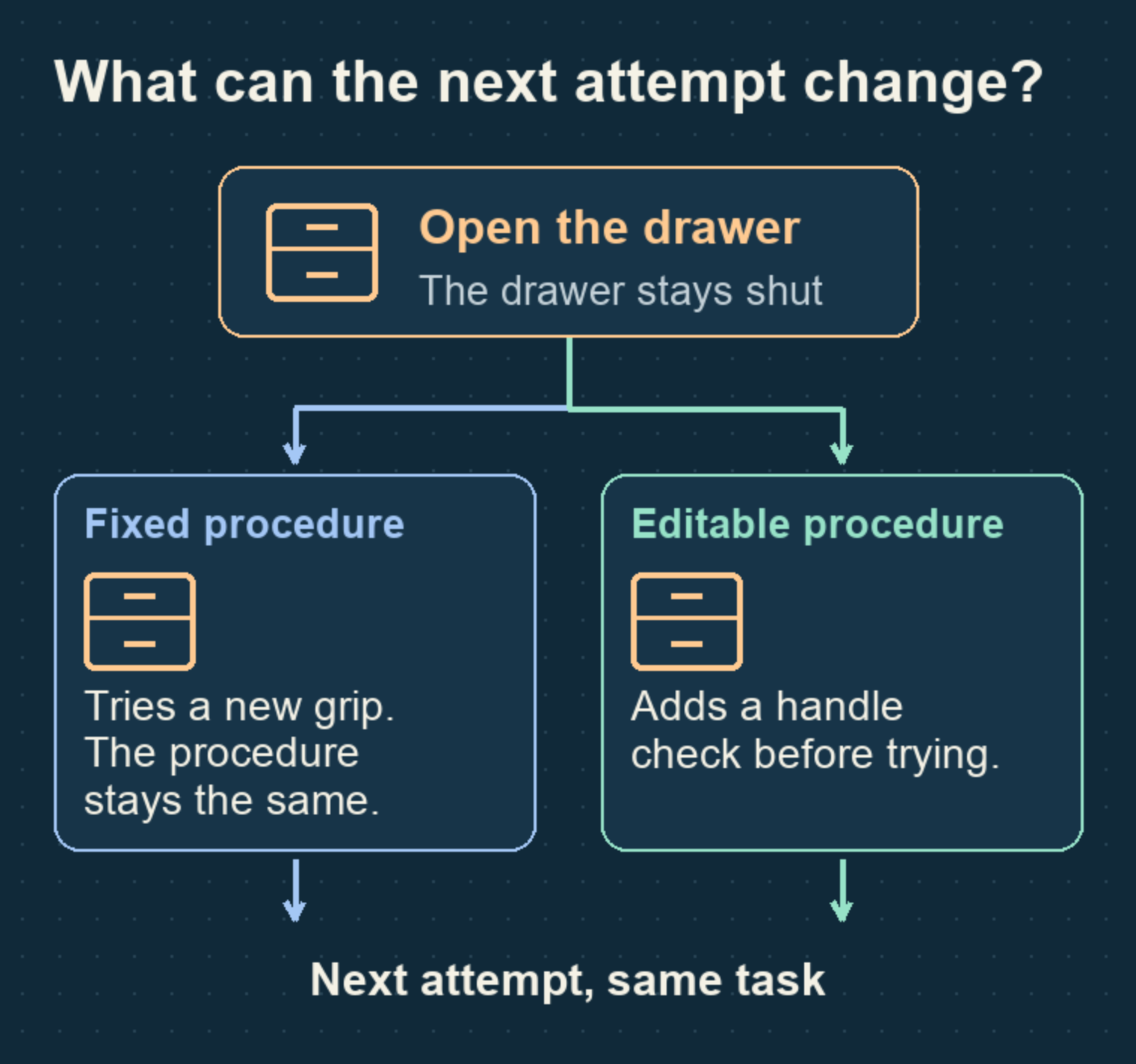
Imagine, as an example to explain the process, a simulated robotic arm that reaches out, pulls a drawer, and the drawer does not move. On the next attempt, it can adjust its grip and pull again. Or it can change the script it follows and add a check of the handle’s position before pulling. A recent study measures whether changing the script, and not just the attempt, leads to better results on a final exam, run on data kept separate during the rounds.
Fixing the attempt or the script
The difference lies in what changes from one attempt to the next. Adjusting the grip changes the attempt, and adding the check changes the procedure used to try again. Neither change, on its own, guarantees that the next attempt will succeed.
The study applies this distinction to artificial intelligence agents, programs that carry out a task in several steps, such as running code or controlling a robot, instead of just answering a question. Inside each agent, a language model reads the instructions and decides the answer or the next action. This model works guided by instructions, tools and a workflow, a set the field calls a harness, the same word used for the gear that guides a draft animal.
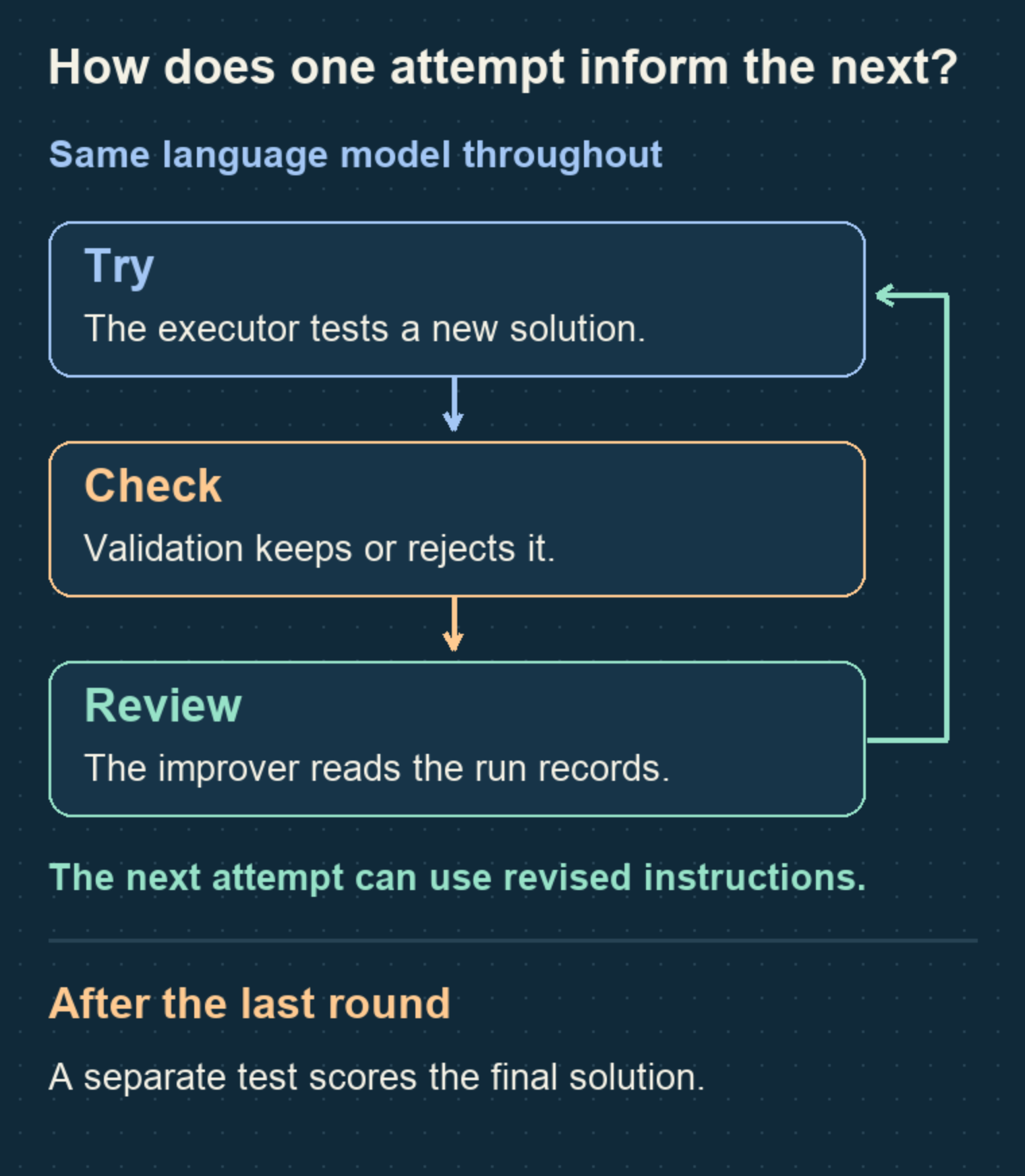
The cycle alternates between two roles, both played by the same language model. In the executor role, the model tries to solve the task and can propose changes to the solution. In the improver role, it reads the history of attempts and can rewrite the instructions, tools and workflow used by the executor. The model stays the same from start to finish.
What the study measures
The study, called Flex-RSI, measures whether this revision cycle improves agents’ scores on varied tasks, from simulated robotics to 3D object tracking. There are 24 tasks and 18 models, although not every model ran on every task. The weights of the evaluated model, the numerical parameters learned during training, stayed fixed throughout the experiment.
To separate rehearsal from exam, each task’s data is split into three parts. The development split is the rehearsal, where the executor experiments. Validation is a separate sample that decides which candidate solution stays. The final test remains held out and hidden throughout the entire cycle, plays no part in choosing candidates, and gives the score of the final solution.
The order of each round
Each round follows an order. In the executor role, the model’s task is to solve the problem, and to do so it can modify the solution, run experiments and track the result on the development split. Validation decides whether the candidate stays or the change is reverted. Next, in the improver role, the same model reads the accumulated records, with trajectories, experiments and scores, and can change the executor’s instructions, tools and workflow, as well as the configuration of the review role itself. These changes take effect in the following round. At the end, the held-out test scores the final solution, from outside the cycle.
Same model, with and without revision
To find out whether revision makes a difference, the researchers set up pairs. In each pair, the same model takes on the same task twice, with the same budget, the same protocol and the same initial seed, the number that starts the random number generator. What differs is the improver role. In one run, the procedure stays fixed and only the solution is redone. In the other, the improver is active and can edit the executor and its own configuration. In total, there are seven pairs across four tasks.
In the scoreboard below, each row is a pair. The “Arm” column, when it appears, indicates the model and the task together. Next to it comes the difference between the two runs, followed by the held-out test score with the fixed procedure and the score with revision active. A positive difference indicates that the run with revision did better on the held-out test. The preprint gathers these results in Table 8.
| Arm | Difference | Fixed | Revised |
|---|---|---|---|
| DeepSeek-V4.1 Flash — Abrir gaveta | 40.0 | 0.0 | 40.0 |
| Qwen3.8-Flash-Next — Busca ativa | 38.3 | 21.0 | 59.3 |
| Qwen3.8-Flash-Next — Abrir torneira | 20.0 | 0.0 | 20.0 |
| Qwen3.8-27B — Busca ativa | 18.3 | 50.7 | 69.0 |
| Qwen3.8-27B — Rastreamento 3D | 6.5 | 45.9 | 52.4 |
| Qwen3.8-Flash-Next — Rastreamento 3D | 2.0 | 56.9 | 58.9 |
| Claude Opus 5.5 — Abrir torneira | 0.0 | 80.0 | 80.0 |
Source: Pares da Tabela 8 do preprint Flex-RSI (arXiv 2611.08946v1), compilados no acervo do Fuad Digital (23/11/2026)commit 02045852d82eMethodologyDownload JSONDownload CSV
Six pairs go up, one ties
With revision active, the held-out test score rose by 2.0 to 40.0 points in six pairs and tied in the seventh. The drawer from the opening is also in the study. On the open-drawer task in RoboCasa365, a household manipulation simulator, DeepSeek-V4.1 Flash went from 0.0 to 40.0. There the score is the success rate over five episodes, and 40 points amount to two more successes. The remaining rows are in the scoreboard.
The tie belongs to Claude Opus 5.5 on opening a faucet, with 80.0 in both runs. In the caption of Table 8, the study records one more run with revision active, under the same settings, which scored 40.0. Between these two runs with revision, the difference was 40 points, or two successes in five episodes, the same size as the jump on the drawer. This record concerns only this pair.
The limits of the comparison
The pairs match the configuration, but not the number of rounds completed. It differs in all seven pairs, and in six of them the run with revision completed more rounds. Each difference therefore compares the cycle with revision to the fixed procedure with this gap in rounds built in. The study reports the pairs descriptively, without a significance test. These are seven specific combinations of model and task, and the conclusions apply only to these pairs.
There is also a question the table does not answer. In the seven pairs shown in the table, one side has the improver turned off and the other has the right to edit itself. In these pairs, the contribution of changing its own configuration is not isolated. Isolating it would take a different design, in which both sides would edit the executor and have the same starting conditions, but only one could change the improver’s configuration.
Validation is not the final exam
Another result from the study compares, in each run, the score of the initial solution with the best score reached on validation, the sample used to choose candidates. Of the 177 runs, 150 improved on this measure, about 85%. Considering all 177 runs, and not just the 150 that improved, the median gain was 10.4 points on a scale of 0 to 100. Since validation is the sample that chooses the solution, this rate is not equivalent to an improvement on the held-out test, nor does it measure the effect of revising the procedure.
What other work has measured
Other studies help place the result without filling the gap. In Meta-Harness, a separate optimizer program searches for better versions of the harness, based on previous versions, the scores they got and the execution logs, always around a fixed model. That is different from a review role that rewrites its own configuration. Hyperagents combines into a single editable program the agent that does the task and a second agent that improves it, and studies what happens when the improvement process itself can also be modified, but in other environments.
RRSI measures the performance of the final procedure, kept fixed, on datasets separate from the ones that guided the search for it. Measuring this transfer matters, because doing well on the data used to tune the procedure is not enough to show that it works elsewhere.
Agent draft from the listed sources; reviewed and approved by Lucas Fuad